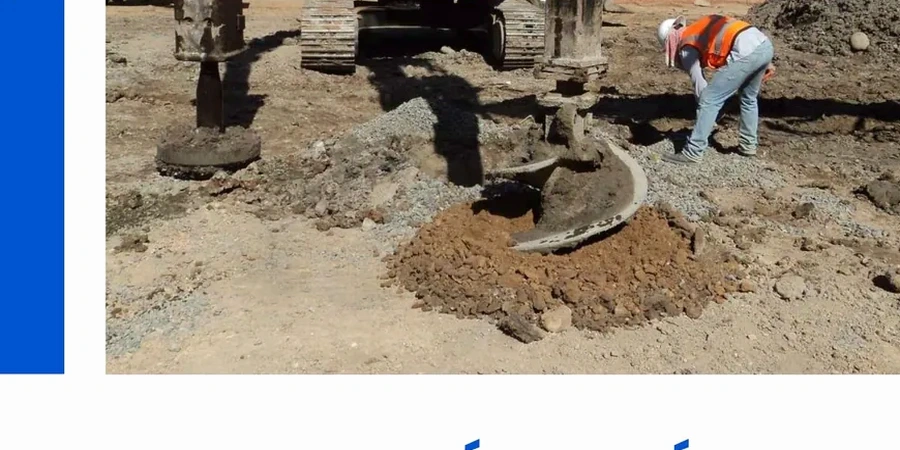
Builders in Columbia South Carolina run into a specific headache more often than they expect. They excavate a few feet, hit what looks like decent residual soil, and assume the bearing capacity will hold for a shallow foundation. Then the mica-rich saprolite from the Piedmont weathering profile does what it always does: it compresses unevenly under load, and the floor slabs start showing hairline cracks within the first year. We have seen this pattern repeat across projects near the Congaree River floodplain, where alluvial lenses sit above partially weathered gneiss. A conventional fill-and-compact approach rarely solves the problem because the compressible layer can extend 15 to 25 feet deep. Stone column design shifts the load transfer mechanism through a matrix of compacted gravel columns that densify the surrounding soil and provide vertical drainage, reducing both total and differential settlement. For sites where the water table sits high, which is common in Columbia given its location at the confluence of the Broad and Saluda Rivers, we often combine the stone column layout with a pre-treatment soil investigation using CPT testing to map the soft zones continuously before selecting the column grid spacing.
In the residual soils of the South Carolina Piedmont, stone columns do more than reinforce: they create a drainage network that accelerates consolidation in saturated silts.