GEOTECHNICAL ENGINEERING
COLUMBIA SOUTH CAROLINA
HomeLaboratoryLaboratory CBR test

Laboratory CBR Testing in Columbia SC: Subgrade Strength for Pavement Design

Technical studies that support your project.

LEARN MORE

One of the most persistent errors we see with pavement projects in the Columbia area is treating every subgrade the same—assuming a generic bearing capacity without verifying it. South Carolina's Piedmont region, where Columbia sits at the fall line between the Sandhills and the coastal plain, presents a tricky mix of residual micaceous silts, sandy clays, and weathered granitic saprolite. A pavement section designed on an assumed CBR of 6% that encounters a subgrade with an actual soaked CBR of 2% will rut within the first two seasonal cycles. The CBR road test standard becomes the only reliable way to translate local soil behavior into a pavement thickness that works, not just on paper but through Columbia's humid summers and occasional freeze-thaw mornings. Before committing to asphalt or concrete, we always recommend pairing the CBR with a Proctor test to confirm compaction targets, because density and bearing capacity are inseparable in pavement performance.

A soaked CBR value below 3% in Columbia's micaceous silts typically triggers the need for subgrade stabilization or a thicker aggregate base layer.
Our service areas

How we work

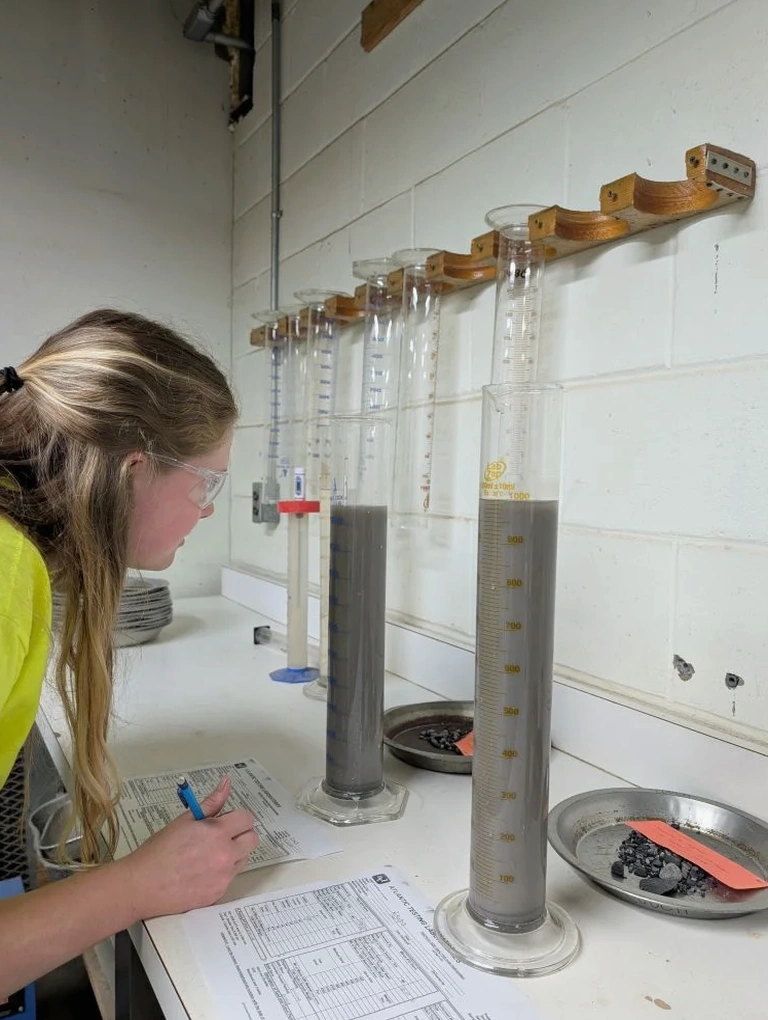
ASTM D1883 sets the framework, but applying it correctly in Columbia requires an understanding of how local soils respond to saturation. The standard laboratory CBR procedure involves compacting a soil specimen at optimum moisture content—determined via AASHTO T-180 or ASTM D698—then submerging it in water for 96 hours to simulate the worst-case field condition after prolonged rain. Columbia averages over 45 inches of rainfall annually, and the water table in areas near the Congaree and Broad Rivers often sits within five feet of the surface. Under these conditions, a soil that looks competent when dry can lose more than 60% of its bearing capacity when soaked. Our lab runs the penetration test using a calibrated loading press at a rate of 0.05 inches per minute, recording the load required to drive the piston to penetrations of 0.1\" and 0.2\". The corrected CBR value at 0.1\" typically governs design unless the 0.2\" value is higher, which sometimes occurs in well-graded gravels. Because Columbia's subgrades often contain fine micaceous particles, we also cross-check the grain size distribution to quantify the silt fraction, since materials with high mica content can yield misleadingly high dry CBR values that collapse under saturation. The laboratory CBR test produces a single number, but interpreting that number correctly depends on understanding the mineralogy, moisture sensitivity, and compaction curve of the specific borrow source or cut section.
Laboratory CBR Testing in Columbia SC: Subgrade Strength for Pavement Design
Technical reference — Columbia South Carolina

Local considerations

A recent pavement failure we analyzed occurred on a commercial access road off Two Notch Road where the designer had relied on a single unsoaked CBR value from a preliminary geotechnical report. The subgrade was a reddish-brown silty sand—typical of the Wateree formation—that tested at 14% CBR in its natural moisture state. After two years of truck traffic and seasonal groundwater rise from a nearby retention pond, the asphalt developed alligator cracking across the entire driving lane. Subsequent soaked CBR tests on undisturbed samples from the failed section returned values between 2.5% and 3.2%. The original pavement section had only 4 inches of graded aggregate base over 2 inches of asphalt, adequate for a CBR of 10% or higher but wholly insufficient for a sub-3% subgrade. The repair required full-depth reclamation, lime stabilization to a depth of 12 inches, and an additional 4 inches of dense-graded base course. The lesson is straightforward: a laboratory CBR test without the 96-hour soaking protocol is not a CBR test—it is a misleading snapshot that underestimates the plasticity and moisture sensitivity of Columbia's Piedmont residual soils. We also recommend flexible pavement design analysis that layers the soaked CBR into the structural number calculation, rather than using it as a stand-alone pass/fail criterion.

Need a geotechnical assessment?

Reply within 24h.

Email: contact@geotechnical-engineering.vip

Applicable standards

ASTM D1883-21, ASTM D698-12, ASTM D1557-12e1, AASHTO T-193, SCDOT Standard Specifications for Highway Construction (2020)

Typical values

ParameterTypical value
Test StandardASTM D1883-21
Specimen CompactionStandard (ASTM D698) or Modified (ASTM D1557)
Soaking Period96 hours (4 days) under water
Surcharge Weight10 lb (simulates 6\" pavement)
Penetration Rate0.05 in/min
Reported CBR at 0.1\"Corrected to standard crushed stone
Typical Columbia ValuesSilty sand: 5–12%; Clayey silt: 2–6%

Common questions

What does a laboratory CBR test cost in Columbia, SC?
Why is the 96-hour soaking period necessary for Columbia soils?

Columbia's residual soils contain partially dehydrated clay minerals and mica that slowly absorb water over days, not hours. The 96-hour soak simulates long-term saturation conditions after seasonal rainfall or a rising water table. Shortening this period can overestimate the CBR by 30 to 50 percent, leading to under-designed pavement sections that fail within the first few years.

How many CBR samples do I need for a typical commercial parking lot in Columbia?

We recommend a minimum of three CBR specimens per distinct soil unit encountered. For a typical 2-acre commercial lot with relatively uniform subgrade, that means one set of three specimens from the predominant material. If the site crosses a geologic boundary—common along the Sandhills fall line—you may need two or three sets. Each set should include at least one sample compacted at optimum moisture for the soaked CBR determination.

Location and service area

We serve projects across Columbia South Carolina and surrounding areas.

View larger map