GEOTECHNICAL ENGINEERING
COLUMBIA SOUTH CAROLINA
HomeIn-Situ TestingField density test (sand cone method)

Field Density Testing in Columbia SC | Sand Cone Method

Technical studies that support your project.

LEARN MORE

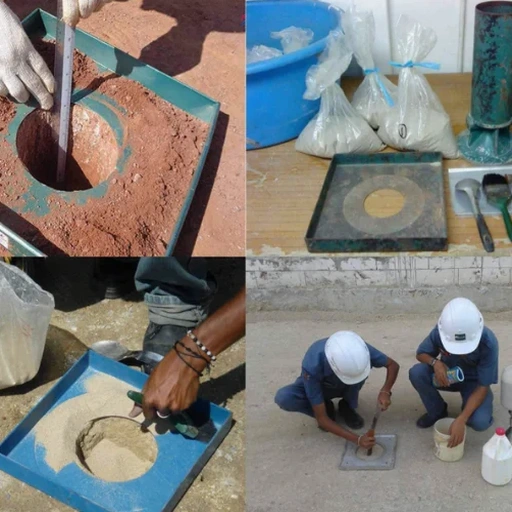
Columbia's red clay and silty sands react badly to moisture swings. You compact a building pad or utility trench, it rains overnight, and the surface looks fine until the nuke gauge or sand cone tells a different story. We run field density tests across Richland and Lexington counties under the same hot, humid conditions your crew faces. The sand cone method (ASTM D1556) gives us a direct volume measurement no nuclear gauge can dispute. When the IBC or project spec calls for 95 percent of modified Proctor, we verify it with calibrated sand and a controlled field procedure. For deeper layers before backfill, we often pair this with in-situ permeability to check drainage at the same time.

A passing proof-roll doesn't guarantee density. We measure compaction by pulling a known volume of sand from the ground, not from a screen.
Our service areas

How we work

Last year on a warehouse pad near I-77, the structural fill passed proof-rolling but failed three sand cone tests in a row. The issue was moisture content above optimum, trapped by a sudden summer storm. We drilled down with a hand auger, ran the test at the lift bottom, and confirmed the contractor had to scarify and recompact the upper 12 inches. Our field density tests use Ottawa sand that meets ASTM C778 gradation. Calibration factors are checked daily against a reference mold. The process covers the plate-to-surface fit, the excavation depth, and the mass of sand in the cone correction. We report wet density, dry density, moisture content, and percent compaction relative to the lab standard. For fill materials with significant gravel, we adjust the test volume and often run a companion Proctor test from the same lift to keep the reference curve tight.
Field Density Testing in Columbia SC | Sand Cone Method
Technical reference — Columbia South Carolina

Local considerations

Columbia's growth along the Broad and Saluda river corridors has pushed development onto residual soils and old floodplain deposits. These profiles vary from micaceous silts to fat clays within a single block. Skipping field density verification on utility backfills under roads leads to differential settlement that cracks asphalt within two seasons. In commercial foundations, under-compacted lifts beneath floor slabs cause slab curling and joint spalling. We have seen compaction issues become warranty claims when the owner's testing agency finds densities below 90 percent months after the pour. A sand cone test, run at the time of placement, costs a fraction of a slab replacement. The IBC requires density testing on compacted fill supporting structures; our reports meet that requirement and give the engineer a defensible record.

Need a geotechnical assessment?

Reply within 24h.

Email: contact@geotechnical-engineering.vip

Applicable standards

ASTM D1556 - Standard Test Method for Density and Unit Weight of Soil in Place by the Sand-Cone Method, AASHTO T 191 - Density of Soil In-Place by the Sand-Cone Method, ASTM C778 - Standard Specification for Standard Sand, ASTM D698 - Standard Test Methods for Laboratory Compaction Characteristics of Soil Using Standard Effort, ASTM D1557 - Standard Test Methods for Laboratory Compaction Characteristics of Soil Using Modified Effort, IBC Chapter 18 - Soils and Foundations

Typical values

ParameterTypical value
StandardASTM D1556 / AASHTO T 191
Test depth4 to 8 inches typical (one lift)
Sand typeASTM C778 graded Ottawa sand
Cone correctionDaily calibration per field mold
Reported valuesWet density, dry density, moisture, % compaction
Soil suitabilityCohesive and granular soils, max particle 1.5 in
Target compaction90–98 % Standard/Modified Proctor

Common questions

How much does a sand cone field density test cost in Columbia SC?
How many sand cone tests does the IBC require per lift?

The International Building Code references the project's geotechnical report for the testing frequency. A common specification is one test per 2,500 square feet per lift, or one per 150 cubic yards of fill placed, with a minimum of three tests per lift for any area. We follow your engineer's approved testing plan.

Can you run a sand cone test on crushed stone base?

Yes, provided the maximum particle size does not exceed 1.5 inches. For larger stone, we switch to a water replacement method or use a large-scale field density test following ASTM D5030. The sand cone plate must seal against the surface, so we grade the test spot smooth before starting.

Do I need a Proctor test before field density testing?

Yes. Without a Proctor curve (ASTM D698 or D1557), we cannot calculate percent compaction. We can run the Proctor in our lab from a bulk sample of the fill material before earthwork starts, or pull a sample from the first lift and fast-track the result.

Location and service area

We serve projects across Columbia South Carolina and surrounding areas.

View larger map